Therapeutic Interventions for Autism

All contents of this resource were created for informational purposes only and are not intended to be a substitute for professional advice, diagnosis, or treatment. Always seek the advice of your physician, therapist, or other qualified health providers with any questions or concerns you may have.
Therapeutic interventions can help your child learn and develop skills that lead to independence. The most common therapeutic interventions for autism are occupational therapy, speech therapy, physical therapy, and Applied Behavior Analysis (ABA). Additionally, many complementary therapeutic options target specific challenges and learning styles. This article briefly describes traditional and complementary therapies as well as information about providers and possible funding sources.
Choosing Therapies and Therapists
When researching and selecting therapies, keep in mind that play and therapy are the work of a child with autism. Therefore, please be sure to include plenty of free time in your child’s schedule so they can relax and participate in activities of their choice. After all, a life with balance includes rest.
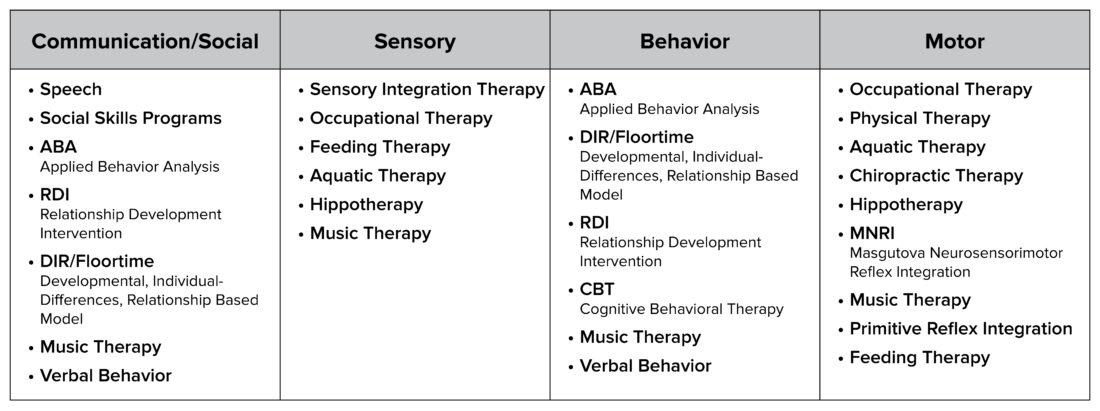
The following chart provides examples of therapeutic interventions that address specific challenges.
To help you determine which therapies and therapists are a good fit for your child, we offer the following suggestions:
Choosing Therapies:
- Make a prioritized list of your child’s needs.
- For example, does your child have a way to communicate their needs, feelings, and knowledge effectively? If not, make communication a priority.
- Identify your child’s learning style and search for therapies that are compatible with it.
- Consider your family’s finances, values, and time.
Choosing Therapists:
- Keep in mind that not every therapist will be a good fit for your child.
- Get recommendations from other families.
- Interview therapists and request to observe sessions.
- Above all, remember that there are good and bad professionals in every field.
- Therefore, watch your child for warning signs of abuse or neglect! If you feel apprehensive, stop the therapy and re-evaluate.
- Read TACA’s article on Risk Reduction Strategies for Physical and Sexual Abuse to learn more.
Traditional Therapeutic Interventions

Below, you will find a brief description of the most common therapeutic interventions for autism and information about providers and possible funding sources.
Speech Therapy
Speech Therapy focuses on improving communication and feeding skills, including oral motor development, verbal language skills, Augmentative and Alternative Communication (AAC), social communication, and feeding therapy.
During the initial evaluation process, a Speech-Language Pathologist (SLP) will assess your child’s understanding of language and their ability to communicate through non-verbal and verbal gestures. Additionally, SLPs can evaluate your child’s ability to chew and swallow food and liquids to develop a treatment plan.
Providers:
- Speech-Language Pathologist
Possible funding sources:
- Private health insurance
- Medicaid
- Public school district
- ECI
- Private pay
Occupational Therapy (OT)
Occupational Therapy (OT) assists your child in performing activities of daily living (ADL) such as manipulating toys in play, handwriting, dressing, feeding, bathing, and working.
During the initial evaluation process, an Occupational Therapist will evaluate your child’s trunk and upper body strength, joint range of motion, muscle tone, fine motor milestones, hand-eye coordination, manipulation of objects within their hands, sensory (sight, smell, hearing, touch, taste) awareness, and activities of daily living. Afterward, the therapist, along with your input, will develop goals for your child and a plan of how to achieve these goals.
Providers:
- Occupational Therapist
Possible funding sources:
- Private health insurance
- Medicaid
- Public school district
- ECI
- Private pay
Physical Therapy (PT)
Physical Therapy (PT) focuses on gross motor development, including coordination, movement, balance, gait, motor imitation, and play skills. In addition, physical therapists work with adaptive equipment like braces, seating devices, wheelchairs, and specialized car seats.
Providers:
- Physical Therapist
Possible funding sources:
- Private health insurance
- Medicaid
- Public school district
- ECI
- Private pay
Behavior Therapies
Several different behavioral therapies are available, which can leave parents feeling confused about which approach to take. Below, you will find a brief overview of the most common behavior intervention programs for use as a starting point in determining whether or not behavior therapy is a good fit for your child and, if so, which approach best meets their unique learning style and needs.
Applied Behavior Analysis (ABA)
Based on B.F. Skinner’s theory of Behaviorism, Applied Behavior Analysis (ABA) therapy aims to improve adaptive learning skills, communication, and behavior through breaking down tasks into small steps, repetition, and reinforcement. ABA therapists train Register Behavior Technicians (RBTs) to implement your child’s treatment plan. Research-based evidence shows benefit from therapy when a child receives 20-40 hours of ABA therapy per week. ABA is the only therapeutic treatment for autism approved by the FDA.
Providers:
- Board Certified Behavior Analyst (BCBA)
Possible funding sources:
- Private health insurance
- Medicaid
- Public school district
- ECI
- Private pay
DIR/Floortime
Developmental, Individual-differences, Relationship based model (DIR/Floortime) is a child-centered, play-based therapeutic model that focuses on reaching functional emotional developmental milestones to create a foundation for learning and development.
Providers:
- Certified DIR therapists
- Psychologist
- Occupational Therapist
- Board Certified Behavior Analyst (BCBA)
Possible funding sources:
- Private health insurance
- Medicaid
- ECI
- Private pay
- Some BCBAs incorporate DIR/Floortime, but bill insurance for ABA therapy
Relationship Development Intervention (RDI)
Relationship Development Intervention (RDI) is a behavior therapy where parents are trained by RDI Consultants to implement a cognitive-development program based on positive relationships, family connectedness, shared experiences, flexible problem solving, and resilience.
Provider:
- RDI Consultants train parents to implement RDI at home
Possible funding sources:
- Private health insurance
- Private pay
Complimentary Therapeutic Options

Below is a brief description of some other types of therapeutic interventions available and possible funding sources.
(Options are listed in alphabetical order for convenience)
Aquatic Therapy
Aquatic Therapy is physical therapy that takes place in a pool. Additional benefits to physical therapy performed in water include:
- Sensory stimulation from hydrostatic pressure.
- Water resistance for strength training.
- Body awareness.
Providers:
- Physical Therapist
Possible funding sources:
- Private health insurance
- Medicaid
- Private Pay
Chiropractic Therapy
In Chiropractic therapy, misalignments of the spine, called subluxations, are manually corrected. This alleviates pressure on nerves and improves nervous system functioning. In addition, specially trained chiropractors can evaluate for primitive reflex integration and provide nutritional guidance.
Providers:
- Board Certified Doctor of Chiropractic
- Pediatric Chiropractors are certified through the International Chiropractic Pediatric Association (ICPA)
Possible funding sources:
- Private health insurance
- Medicaid
- Private pay
Cognitive Behavioral Therapy (CBT)
In Cognitive Behavioral Therapy (CBT) specially trained therapists work with individuals and families to strengthen mental health, develop coping strategies, and improve emotional regulation. Common issues addressed are anxiety, depression, anger, eating disorders, and difficulty handling stress.
Providers:
- Psychiatrist
- Psychologist
- Licensed Clinical Social Worker
Possible funding sources:
- Private health insurance
- Medicaid
- Private pay
Feeding Therapy
In Feeding Therapy, a speech therapist, occupational therapist, or both will evaluate and implement a treatment plan for feeding issues, including sucking, chewing, swallowing, gagging, and sensory defensiveness with food textures. In some circumstances, feeding therapists consult nutritionists or dieticians for nutritional advice.
Providers:
- Occupational Therapist
- Speech-Language Pathologist
Possible funding sources:
- Private health insurance
- Medicaid
- ECI
- Private pay
Hippotherapy
Hippotherapy utilizes horses as a therapy tool for improved sensory, neuromotor, and cognitive development.
Providers:
- Hippotherapy certified:
- Physical Therapist
- Occupational Therapist
- Speech-Language Pathologist
Possible funding sources:
- Private health insurance
- Medicaid
- Private pay
Masgutova Neurosensorimotor Reflex Integration (MNRI)
In Masgutova Neurosensorimotor Reflex Integration (MNRI),, specially trained professionals assess and create a treatment plan for primary motor reflex patterns and integration.
Providers:
- MNRI Certified Practitioners:
- Occupational Therapist
- Physical Therapist
Possible funding sources:
- Private health insurance
- Private pay
Music Therapy
In Music Therapy, therapists use music as a tool to address behavior, communication, sensory, motor, self-regulation, and cognitive functioning.
Provider:
- Certified Music Therapist
Possible funding sources:
- Private health insurance
- Private pay
Neurofeedback
Also referred to as EEG biofeedback, Neurofeedback utilizes computer-based brain training to analyze and retrain the client’s brainwave activity to a more controlled pattern.
Provider:
- Psychiatrist
- Psychologist
- Naturopathic doctor with specialized training
Possible funding sources:
- Private health insurance
- Private pay
Primitive Reflex Integration
Primitive reflexes are naturally present in infancy and disappear through normal development. However, reflexes that do not integrate may contribute to developmental delay and sensory issues. Therefore, in Primitive Reflex Integration therapy, professionals assess and develop treatment plans for retained primitive reflexes.
Providers:
- Occupational Therapist
- MNRI Provider
- Brain Balance Center
- Functional Neurologist
- Chiropractor
Possible funding sources:
- Private health insurance
- Medicaid
- Private pay
Sensory Integration Therapy
In Sensory Integration therapy, specially trained occupational therapists expose people with sensory processing issues to various sensory stimuli and play-based activities in a structured, thoughtful way.
Provider:
- Occupational Therapist
Possible funding sources:
- Private health insurance
- Medicaid
- Public school district
- ECI
- Private pay
Social Skills Programs
Social Skills programs use direct instruction and repetition to teach social skills. Examples of the various techniques therapists use to help develop social skills include role-playing, Social Stories, social scripts, typical peers, or standardized curriculums.
Providers:
- Board Certified Behavior Analyst (BCBA)
- Psychologist
- Public School District
- Social Worker
Possible funding sources:
- Private health insurance
- Public school district
- Private pay
Verbal Behavior (VB)
Based on the principles of ABA, Verbal Behavior (VB) teaches communication through connecting words to their function or purpose. Specifically, VB therapists divide words into four types: echoics (repeated words), mands (requests), tacts (labels), and intraverbals (responses/answers).
Providers:
- Board Certified Behavior Analyst (BCBA)
- Speech-Language Pathologist
Possible funding sources:
- Private health insurance
- Medicaid
- Public school district
- ECI
- Private pay